Friday, May 2, 2014

Deepest sorrow over the passing of Juan Formell

With deep sorrow, cultural authorities of Cuba's announced the death of Juan Formell, founder and director of the popular band Los Van Van, who for his career received the National Music Prize and the Latino Granmy for Musical Excellence. The death of renowned arranger, composer, singer and record producer leaves a void in popular dance music, to which he contributed with the creation of “songo” and the rhythm of " buey cansao”, remembered by generations of Cubans. Formell was born in Havana on August 2, 1942 and received his early education from his father Francisco Formell. But later he continued his music studies by self-taught. His artistic career was marked by his entry into the Revé Orchestra, led by Elio Reve, who in his own words, taught Formell much of what he would later apply in the group he formed and named Los Van Van. During his more than five decades of professional life, Formell recorded more than 20 albums and received several laurels, including the Grammy Award for his CD "Llegó... Van Van" (Van Van is here). In 1999 and 2010 he received an honorary doctorate from the Higher Institute of Arts in recognition of his contributions to Cuban culture.

Tuesday, April 29, 2014

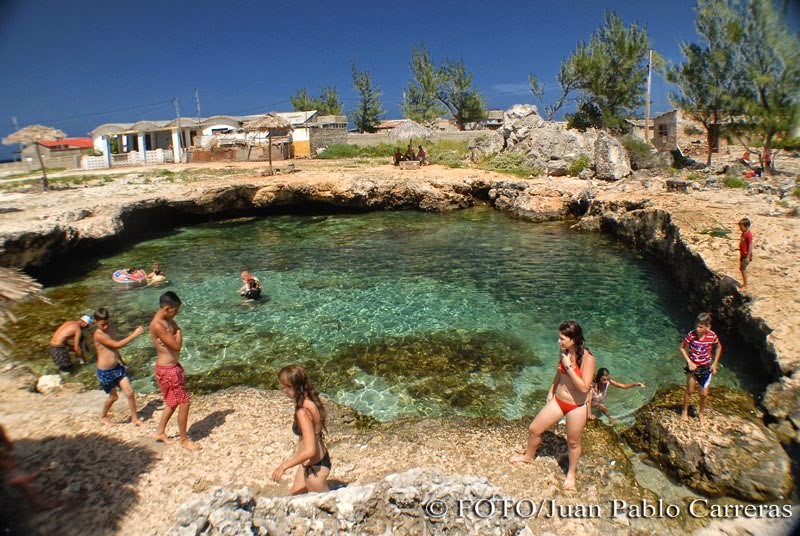
Poza Fria of Caletones Beach, Gibara

The Poza Fria of Caletones is one of the flooded-caves of Laguna Blanca-Caletones Caves System that most attract attention of vacationers. It's a natural pool located among summer houses, just a few meters from the road entering Caletones beach. Caletones is an isolated beach in the coastal town of Gibara with Beatiful landscapes which were devastated after the passage of Hurricane Ike through the territory. Most vacationers coming here are from then same province of Holguin and Gibara. The poza fria is characterized by a large dolina with easy access to two galleries, one facing east and the other one to the south. The one directing to the east is of difficult morphology due to the number of landslides, which makes exploration quite dangerous, as there is a strong current that leads to that direction. The dolina running to the south is parallel to a large crack in the many existing in the area, a landslide near a restriction stops exploration. The total distance in this cavity reaches 85 m. / Photo by Juan Pablo Carreras

Thursday, April 3, 2014

Banes becomes tourist destination for cruise ships

Banes has become a place of interest for cruises. Every Wednesday one of these huge ships arrives at Antilla Bay. According to guidebooks, Banes is a destination for its archaeological values. It has been of great interest to visitors to explore the historic city center and the Catholic church of this city. However this tourist option leads to other new interests, as it happen with tourists from the Caribbean such as Jamaicans who want to meet ancestors living in the neighborhood of Mariana Grajales and have been guided there to establish contact with friends and families there. "This model of tourism brings people from Denmark, Norway, Canada and Italy. They come with some specific cultural and humanitarian interests, for example, knowing of the Jamaican community residing over Banes”, said Luis Quinones, a guide at the Bani Indocubano Museum of Banes. According to Quiñones with the arrival of cruises, the city of Banes, better known as the Archaeological Capital of Cuba, will also become a place of great tourist interest. “Now we have to improve our work and make the city more attractive to visitors”.

Wednesday, February 5, 2014

Injured, but with a Lot of Optimism  

It is always nice to talk with Holguin's star decathlete Leonel Suárez Fajardo. So hearing about his stay in this city, JIT magazine decided to meet him.   Double Olympic bronze medallist took the optimistic dialogue with eloquence and wisdom that enhance his admirable simplicity.   November 2013 and January 2014 brought joy and motivations to you. Why?   “On November 16, 2013 my daughter was born and the in early days of 2014 the authorities in the province gave me a comfortable home, two highly rewarding things.”   I can assure you that even if the property has been delivered to me due to my outstanding sporting career, I committed myself to increased efforts as sportsman.   I will not disappoint all those who trusted and still trust me. That's the biggest commitment after this recognition, which helps a lot to give myself fully to training, despite being injured now.   How did you get the injury?    After jumping in London 2012 Olympics, I got a little pain in the right knee, which worsened in the 2013 World Championships.   Doctors diagnosed an insersionitis in the kneecap, which causes acute discomfort that prevents me from training hard.   What is the medical treatment?    Specialists at the Frank País orthopaedic hospital in Havana will determine whether I need stem cell treatment or arthroscopy surgery, which promotes the regeneration of damaged tissue.    But I'm ready for the decision made, because the discomfort is unbearable and for me the most important thing is to achieve full recovery as quickly as possible.   So you're resting?    None of that. I train to strengthen the upper body, as I cannot jump or run fast, hence I cannot ensure that I'm training properly, so I can't compete for now.   Not even this year?    Everything is depending on how the injury is assessed in terms of severity and course of treatment response. However I would like to be in good shape for the Central American and Caribbean Games of Veracruz, Mexico, in November.   I'm optimistic, but the future is uncertain for now. It's hard to give an answer.   Wishes?    Back on the podium in world events, which is the same as saying to stay in the top three in the world, I'll never give up on that. / Photo: Rodriguez.Otmaro with information from JIT / Jose Antonio Chapman

Tuesday, January 21, 2014

Foundation of the city of San Isidoro de Holguín

For his feats in the conquest of Mexico the Spanish Crown granted Francisco García Holguín land in the northeastern part of the island from the Jigüe to the Marañon Rivers in 1545, prompting García Holguín, his wife Isabel Fernández de Sandoval, and some followers, to found the first village in the area. Historians say that García Holguín returned to Mexico where he had large extensions of land and died there. Throughout time the village was then surrounded by several other areas called Managuaco, Los Guazumas (Guasimas), Las Cuevas, Cayo Llano and others, and on April 3rd, 1720, on the eve of Saint Isidoro, a church was inaugurated in the urban area, dedicated to Our Lady of the Rosary. In 1752 other churches were added: San Idelfonso and San Miguel which gave names to other streets (today known as Aricochea and Luz Caballero). Spanish King, Ferdinand VI, granted the Title of City to Holguin back on January 18th, 1752. This action resulted in the recognition of the social and commercial growth of the village set up in 1545 by Captain Garcia Holguin when he was granted the land and built the first houses. In 1752, according to historians, the city had a population of 1291 whites and 135 slaves, 211 rustic houses and one public school. The northern part of Holguín between Auras and Gibara was also attacked by the English Navy in the mid-18th century, but Holguineros defended it fiercely, causing more than 70 casualties among the English troops, resulting in the English Navy pullout. In 1863 there were already 76 sugar mills in the area, 753 tobacco plantations and hundreds of farms worked by slaves, evidence of the area’s economic and social growth. / With information from Radio Havana Cuba

Thursday, January 16, 2014

Fher admires Cuba, its people and art

The singer of the Mexican band Maná, Fernando Olvera, expressed his admiration for Cuba and its people, because despite being a small country has an impressive art. Cuba is one of the most extraordinary countries in the world, whose greatness is shown not only by its music, dance, painting and poetry, but also in sports and medicine, said Fher in an interview with the Matanzas' radio broadcasting system, Radio 26. During the conversation, which took place at the Varadero beach, the lead singer of the popular rock band expressed his intention to present soon in Cuba, in a personal capacity. I would like to make it free for people. For me it is a dream to share with all these people who like Mana and do not have the possibility to go to another country to see a concert. Besides, we owe much to Cuban music, from trova to salsa, the artist said. The interpreter of popular themes such as “Vivir sin aire” and “Te lloré un río” said: we still live in the illusion of music, we are not and we were not even for money. ( ... ) We are because we love music and we like to share it with people . " Fher, who tries to go unnoticed in the crowd resting on the peninsula of Varadero, expressed his desire to return to Cuba because it is an amazing country, where despite the economic problems people always have a smile on their face. In message dedicated to the Cuban people, the Mexican artist said he is very pleased that Cubans like the band, in a country that is a seed-bed of artists and musicians as well. He also expressed satisfaction in knowing that on the largest island of the Antilles, the public is familiar with the work of the group as well. "They have sought and found Mana. That touches my heart. Cuba touches my heart ," he said. With information from Cubasi.cu

Tuesday, January 7, 2014

End of the year celebrations

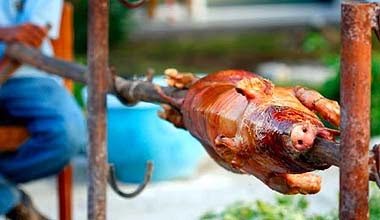
Cubans plan our time and money to have a good new year celebration , but each with our own way to spend this time. Typical dishes consisting of roast pork, turkey or fried chicken, congrí criollo (rice and beans), yuca con mojo, a variety of desserts and of course, the cold beer, are dinner menu. Approaching the 12 hours, most families wait the official time in front of the TV, to celebrate a year of revolutionary triumph. Then comes the hug, congratulations, good wishes and a very common ritual of throwing water out doors. It has to do with the belief of cleaning the bad period left behind and bring feelings of hope for the coming year. Cubans also dress in their best clothes, and there are even those who light candles and place their hopes in the horoscope predictions and zodiac, following recommendations according to the letter. And there are those who decide to change the tradition. Country people coming to town for roasting a pig on a “Pua” and thus enjoy a year-end in the "civilization". Whatever the way Cuban families choose to celebrate the end of the year, we always have fun and joy coming together even more, asking good things for everyone.